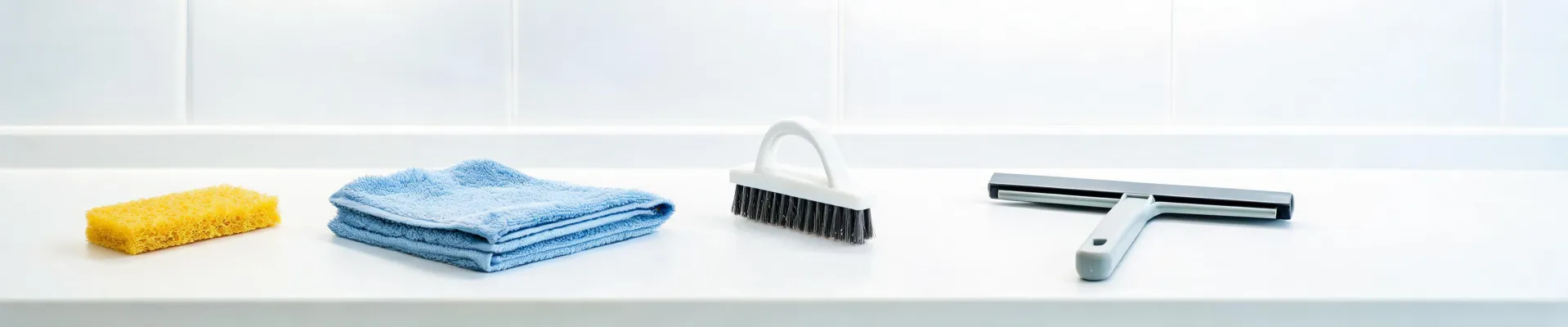
Step out of the shower on a Wednesday morning and there it is—a pale, stubborn film tracing the tile where the water hits, just above the tub. A damp sponge passes over it, smears the shine, and leaves the film intact. That cloudy layer is soap scum: soap residue, body oils, and hard-water minerals that have bonded into a thin, waxy crust. It doesn't surrender to wiping, and the instinct is to press harder or reach for something more aggressive. But the real breakthrough comes from understanding what the film is made of and what actually breaks that bond. The answer is not a stronger chemical or a firmer elbow—it's a pad with the right abrasive structure, moved with a light, sweeping touch. That's the core of the Swift Scrub approach.
The film that wouldn't budge
So what actually breaks that bond? It helps to think of the film as a physical crust, not a chemical stain. The minerals in hard water crystallize into tiny structures that lock onto the tile's microscopic pores and roughness. A soft sponge deforms around those crystals and slides over them, so it never gets a grip. What's needed is controlled abrasion—a pad with hard, pointed particles that can penetrate the scale and shear it off in layers. But abrasion is also a threat: the same action that frees the soap scum can leave fine scratches in a glossy surface. That's why the first choice isn't which chemical to spray; it's which pad to put in your hand. And because bathrooms combine several different surfaces in one compact space, the pad selection has to be considered separately for tile, glass, and acrylic.
Look around a bathroom and you'll see why surface matching makes or breaks the job. Glazed ceramic tile has a hard, glass-like finish, while a tub insert might be acrylic, and a shower door could be tempered glass. Each has a different tolerance for abrasion. A heavy-duty steel wool pad that tears through ceramic grout can fog an acrylic surface permanently. The result is a familiar household standoff: either the buildup stays, or the surface takes the damage. The middle path is a pad engineered for this specific range—one with a controlled abrasive level and a compact shape that lets you apply even, light pressure. That's the kind of tool that turns a frustrating chore into a two-minute pass. It also explains why the same product line includes several versions rather than one universal sponge.
The 3M line behind the scrubbing power
The Scotch-Brite brand behind the Swift Scrub is not a random collection of sponges. According to the company's public product literature, Scotch-Brite is a line of abrasive products produced by 3M, with varying compositions and levels of hardness, covering dish-washing pads and industrial brushes. That lineage matters for a home cleaner. It means the abrasive structure on a bathroom pad is the result of real material engineering, not a foam block with grit glued on. When you pick up a Scotch-Brite product, you're choosing from a family of tools that share the same abrasive science but are tuned for different jobs. The key phrase is 'varying compositions and levels of hardness.' That's the mechanism that makes surface matching possible. The same company that makes a pad aggressive enough to strip industrial coatings also makes a pad gentle enough for a non-stick pan. The Swift Scrub sits in a specific spot on that spectrum—designed for home surfaces that need a lighter touch.
But the engineering only pays off if you recognize the condition attached to it: match the pad to the surface. Because the Scotch-Brite line includes both home and industrial tools, with different hardness levels, assuming 'Scotch-Brite' means one thing is exactly the mistake that leads to scratched glass. The practical condition is to read the label for a surface rating, and to treat abrasive level as a specification. A pad that's perfect for baked-on grease in a metal pan is not automatically right for a fiberglass tub. On a bathroom surface, you want the least abrasive pad that will still cut through soap scum—that's why the Swift Scrub's non-scratch promise is the relevant filter. This is the same discipline a test engineer applies: selecting the right grade of abrasive for the material, rather than grabbing the closest thing under the sink. The evidence from the product line description backs this up: because the company makes such a wide range, the responsibility of choosing correctly shifts to the consumer.
How buildup actually yields
Once you have the right pad, the removal mechanics become a matter of technique. The pad's abrasive points act like tiny cutting teeth. As you sweep it across the film, those points fracture the crystal lattice of the hard-water deposits, turning the crust into dust and sludge that water washes away. The critical insight is that pressure is not a factor. In fact, pressing harder works against you. High force drives the abrasive deeper into the pad's cushion, flattens the cutting points, and grinds particles into the surface—which is how scratches appear. Light pressure keeps the abrasive points exposed and lets them do the shearing. You're essentially letting the pad's texture do the work; your arm just guides it. This is counterintuitive after years of scouring pots, where elbow grease seems to matter. But soap scum is fragile; it's a brittle deposit on a smooth substrate. A gentle, flat pass with a properly graded abrasive will microfracture the deposit without attacking the surface. This is the same principle a professional detailer uses with a light rubbing compound.
For the effect to hold, a few conditions have to line up. First, the pad should be damp—water is the lubricant that carries away the abraded material and keeps the surface cool. Second, use a flat, full-face contact rather than the edge; the edge concentrates force and can gouge a soft finish. Third, sweep in short, overlapping strokes rather than an erratic back-and-forth. A steady pattern lets you see where you've been and prevents re-depositing the loosened grit. And fourth, rinse the pad frequently. A loaded pad is a buffing pad—it won't cut the crust anymore, it'll just smear it. With these conditions, a few passes convert a cloudy film into a clean, shiny surface. Without them, the same pad in the same hand can leave a haze that wasn't there before. This technique condition is exactly what separates a professional result from a disappointing one. You don't need to be strong; you need to be deliberate. The advantage of a well-designed scrubber is that it makes these conditions natural to hit.
Picking your swift scrub and a backup
Choosing which Swift Scrub variant to buy—and whether to keep a backup—comes down to a selection process that testers use in product roundups. Take the 2026 food storage container reviews: they start with criteria like leakproofness, durability, and ease of cleaning, then they filter a crowded field down to a few winners. The mechanism isn't about picking the most famous brand; it's about matching category-specific features to a use case. The same filtering approach works for bathroom scrubbing. Before you look at a pad, define your surface and your problem: is it soap scum on ceramic, a mineral ring in the toilet, or the film on a glass door? Each has a different abrasive tolerance, and that tolerance is the first filter. In the food-storage test, the reviewers narrowed choices by testing with real foods and measuring performance across specific attributes. Here, the simplified filter is the surface type, and the attribute is the pad's rated hardness. That's the practical takeaway: don't buy a scraper; buy a system of options matched to your fixtures.
Applying that filter to the Swift Scrub line, you look for non-scratch rated pads with a handle shape that fits the task. For flat tile, a large, flat pad covers ground quickly; for corners and grout lines, a smaller pad or a brush attachment gets into the gap. That's why a backup makes sense: a dedicated scrubber for the main surfaces plus a detail tool for the edges. The category mechanism doesn't point to one universal product—it points to a set of tools that match the surfaces you actually have. And it also tells you what to ignore: a heavy-duty marine-grade pad that's marketed for fiberglass might be overkill for a shower wall, and an over-engineered tool becomes a storage headache. In the same way the food-storage roundup filtered for leakproofness and stackability, here you filter for non-scratch safety and maneuverability. Those two traits decide whether the tool works for a bathroom or ends up back under the sink.
Keeping the clean from becoming a cycle
Once the film is gone, the trick is keeping it away. Soap scum doesn't form in a day; it builds up from mineral residue that stays behind after every shower. A quick daily swipe with a squeegee removes the water film before it evaporates and leaves crystals behind. On a weekly schedule, a light pass with the Swift Scrub—using the same gentle sweep you already learned—will break down the early deposit before it hardens. Rinse the pad thoroughly after use, stand it so it dries, and it'll keep its abrasive surface for months. Replace it when you notice it's not cutting as cleanly; an exhausted pad is like a worn tire that just smears. A simple habit, like hanging the pad where it drains, also stops bacteria and odor, so the tool stays pleasant to use. And remember that prevention is easier than removal, so a thirty-second daily pass is cheaper than a monthly battle.
That Wednesday-morning ring, the one that made you reach for a sponge and reconsider your life choices? Give it a few passes with a matched, non-scratch pad and a light hand, and it lifts in under a minute—no fumes, no scratches, no arctic-level scrubbing. The method stays with you: identify the surface, choose the pad grade, sweep flat, rinse, and repeat. That's not a routine you have to remember; it's a habit that forms around a tool that fits the job. The film that wouldn't budge becomes the film that finally moves, and the tile underneath still looks like tile. The thesis holds: a Swift Scrub is the fast, non-scratch solution when you match the pad to the surface and use the right sweeping technique. This is the payoff of the approach: not a pristine bathroom that demands constant policing, but a clean surface that stays clean because the habit is easy to repeat. It's the difference between a chore and a maintenance routine.
The ring lifts in one pass.

Ingrid Falk
Ingrid Falk is an outdoor living products analyst specializing in fences, pergolas, gazebos, canopies, greenhouses, shade sails, patio sets, outdoor sofas, and weatherproof cushions. She uses ISO 4892-2 and ASTM G154 weathering methods while comparing UV color change, coating adhesion, corrosion resistance, frame load, joint stability, water shedding, and dimensional movement. Her work helps garden retailers, project buyers, and hospitality operators select structures and furniture suited to wind exposure, climate, installation method, maintenance, and expected occupancy.