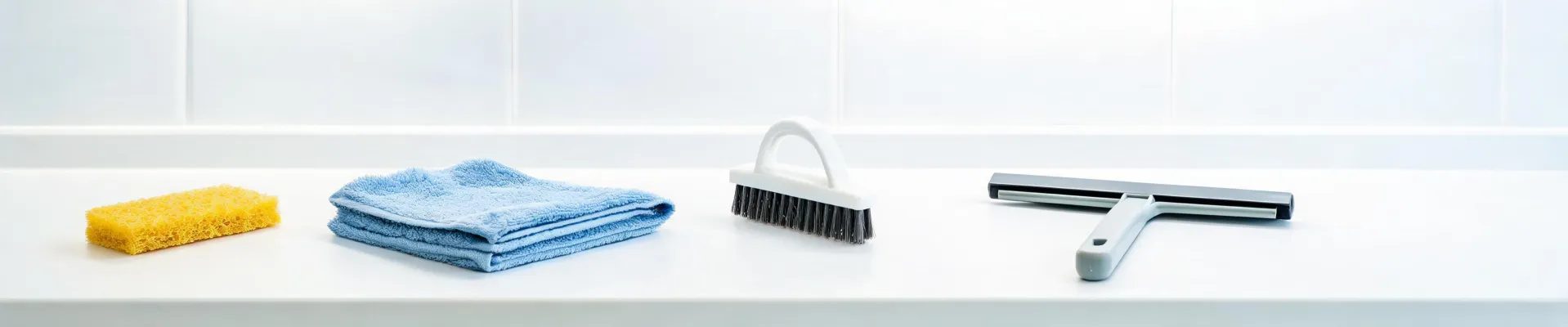
It's Saturday morning and you're standing in the shower with a sponge in one hand and a spray bottle in the other, working a cloudy band that sits at shoulder height across the glass. You have cleaned this panel before—three weeks ago, maybe four—and the band came back in exactly the same place. So you press harder, add more spray, wipe in circles until your arm aches, and the haze doesn't disappear so much as spread: thinner at the edges, thicker in the middle, until the lower half is an even, faintly greasy fog that catches the light when you step out. The water beads differently on it than on the clear glass above. That difference is the first real clue: what you are fighting is not dust on the surface, it is bonded to it.
The Cloudy Band on Your Shower Glass Comes Back in the Same Place
It's Saturday morning and you're standing in the shower with a sponge in one hand and a spray bottle in the other, working a cloudy band that sits at shoulder height across the glass. You have cleaned this panel before—three weeks ago, maybe four—and the band came back in exactly the same place. So you press harder, add more spray, wipe in circles until your arm aches, and the haze doesn't disappear so much as spread: thinner at the edges, thicker in the middle, until the lower half is an even, faintly greasy fog that catches the light when you step out. The water beads differently on it than on the clear glass above. That difference is the first real clue: what you are fighting is not dust on the surface, it is bonded to it.
What is actually on the glass is a stack. Soap scum—the calcium and magnesium salts left when soap meets hard water—lands first, as the thin film every shower leaves behind when it dries. Hard-water scale crystallizes over that film, and in the warm, rarely-dried corners a biofilm settles on top of both. Each layer grips the one beneath it, which is why a wet sponge loosens almost nothing: water softens the outer surface just enough for the sponge to smear it into an even coat, and the coat dries back into the same band. At this point the obvious question—stronger cleaner, or a different tool?—splits in two. A cleaner announces itself on the label; a pad does not, and a listing built around a non-scratch bathroom scrub still leaves you to confirm what a specific pad contains and how hard it bites. That is why I start with the surface rather than the stain.
Soap Dries First, and the Water Leaves Its Minerals Behind
What makes the film durable is the drying cycle, not the washing. Every shower ends the same way: a thin sheet of water carrying dissolved soap and dissolved minerals sits on the glass until it evaporates, and evaporation does not carry those solids away—it leaves them. The soap fraction is soft and slightly tacky, which is why the first days after a cleaning look fine: the film is thin enough to read as haze rather than crust. The mineral fraction, mostly calcium carbonate, dries into a hard, faintly alkaline layer that locks the softer soap beneath it into place. Run that cycle twice a day for a month and you have the layered structure that resists wiping, heaviest where water runs longest.
This mechanism comes with a boundary condition that matters more than the chemistry. A wet wipe only smears when the deposit is already cured and stacked; soap film that is minutes old comes off with water alone. The failure is not that the sponge is bad—it is that the sponge is being asked to do a job it can only do on day one. Once that is clear, the question stops being about detergent strength and becomes about the working edge in your hand. The same limit shows up in the way these tools are sold: a category heading tells you what a class of product is meant to do and stops there, because the choice that actually matters is made against your surface, not read off a shelf. The variable that decides the outcome is how much cutting action the tool puts into the deposit, and how much the surface underneath can absorb.
Scotch-Brite Runs a Whole Ladder of Cutting Strength
The reason I treat Scotch-Brite as the reference point here is structural rather than promotional. It is a line of abrasive products made by 3M, and the same line covers scouring pads and scrubbing tools for home dish washing at one end and industrial abrasive surfaces—discs, belts, rotating brushes—at the other, with varying compositions and levels of hardness across the range. Read that spread as an engineering statement and it says one useful thing: abrasiveness is the variable the line is organized around. A pad that lifts grease from a pan and a disc that grinds a weld smooth are not the same tool at different sizes; they sit at different points on one scale of cutting aggressiveness. So the question is which point on that scale a shower panel tolerates.
Matching runs on two axes at once, and getting one right does not rescue the other. The first axis is the deposit: a thin, fresh haze releases under light cutting, while a stack cured for months needs a sharper edge and more passes before it lets go. The second axis is the substrate: glass, acrylic, glazed porcelain, and grout sit at very different points on the hardness scale, and an edge that clears haze from tile in a few strokes can scar the coating on a shower panel in one. When the two axes disagree—hard deposit, soft surface—you do not get to pick the middle. You take the surface's ceiling, work the deposit in more passes, and accept that a cured layer may come off in stages across several cleanings rather than all at once.
The Panel Sets the Ceiling Before the Stain Does
The routing is mechanical once you accept the surface as the gate. Coated glass and acrylic sit at the top of the risk list: a fine scratch in the coating becomes a slightly rougher spot, water stops sheeting off it, minerals dry there first, and the next haze forms around that scratch. Those surfaces get the lightest, explicitly non-scratch grade, worked wet so grit rinses away instead of being dragged across the glass. Glazed porcelain tile is denser and more forgiving, and a medium scouring pad is reasonable on the flat field—though not along a glazed edge or on a matte finish, where it dulls the surface. Grout lines and inside corners are a shape problem more than a material one: a pad's flat face cannot reach into a joint, so those go to a small brush.
So the sequence only runs one way: identify the substrate, take the lowest grade that will actually move the deposit, and only then decide how long to work it. Reversing the order—picking the pad that looks aggressive enough for the stain and hoping the surface survives—is what produces the panels people describe as permanently scratched. A shelf or a category page can only settle part of that, because such pages sort products by type and intended use; that is good for narrowing the field, but it says nothing about what a given grade is made of, how deeply it cuts, or what it is rated for. For that, the document worth reading is the manufacturer's datasheet, and I would confirm the model-level spec before a new pad goes on a coated panel.
Whether the Band Returns Is Decided After the Scrubbing Stops
The three steps that decide recurrence are dwell time, rinsing, and drying, and none of them involve force. Dwell time is what lets a cleaner break the outer film so the pad cuts softened deposit rather than dry crust; ten minutes of contact does more than ten minutes of scrubbing. Rinsing is the step most people hurry past: everything you lifted has to leave the surface, because if it dries in place as a thin slurry you have laid a base coat for the next film. Then comes drying, which decides whether you clean twice a year or twice a month—a squeegee pass after the last shower removes the water that would otherwise evaporate and leave its minerals behind. Vocabulary matters here too: abrasive, scouring, and non-scratch are different constructions, and a non-scratch pad on a cured mineral layer is not a gentler scouring pad but a tool used outside its job.
My rule, stated so it can be reused on any panel: name the surface, pick the lightest grade that still cuts, and stop when the water sheets instead of clinging. Concretely—coated glass or acrylic gets a non-scratch pad, warm water, a short dwell, then a rinse and a squeegee; glazed tile takes a medium scouring pad on the flat field and a brush at the joints; grout and silicone get the brush and no abrasive grade at all. Pour a cup of water slowly across the band at shoulder height. If it runs off in an unbroken sheet and the glass dries clear behind it, the film is gone and nothing is left to seed the next one. If the water still breaks into beads and patches, you have thinned the deposit without removing it, and the answer is another cycle at the same grade, not a more aggressive pad.
One comparison covers most of it: the lowest grade that moves the deposit against the highest grade the surface will forgive. Pick by the lower of the two, then run the sequence—dwell, rinse, dry—as if the band were due back next week.

Ingrid Falk
Ingrid Falk is an outdoor living products analyst specializing in fences, pergolas, gazebos, canopies, greenhouses, shade sails, patio sets, outdoor sofas, and weatherproof cushions. She uses ISO 4892-2 and ASTM G154 weathering methods while comparing UV color change, coating adhesion, corrosion resistance, frame load, joint stability, water shedding, and dimensional movement. Her work helps garden retailers, project buyers, and hospitality operators select structures and furniture suited to wind exposure, climate, installation method, maintenance, and expected occupancy.