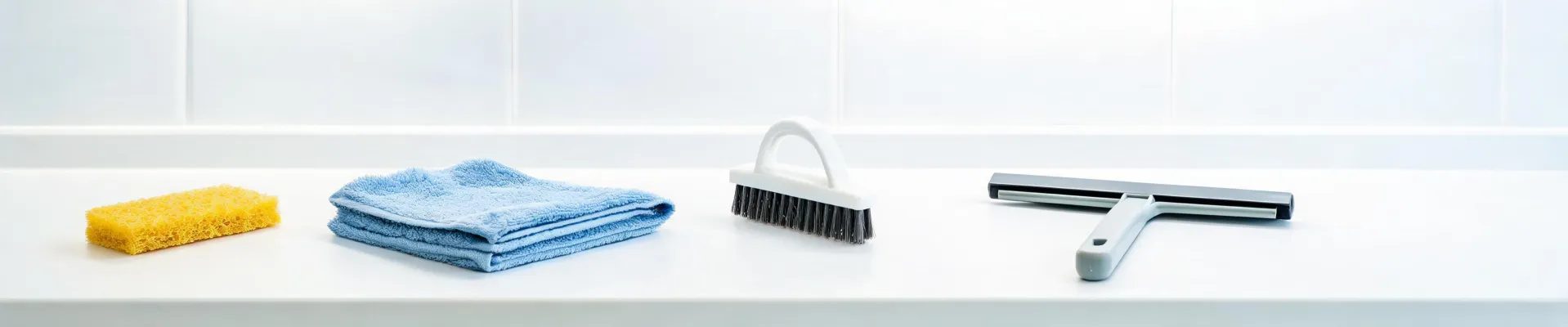
Most shoppers searching for a 3M Scotch-Brite fryer and kitchen cleaning tool are asking the wrong question, and the shelf does not correct them. The assumption is that the lineup runs from mild to brutal and that buying the more aggressive pad is simply buying more cleaning. I think the reverse is closer to the truth: the abrasive grade is not a power setting, it is a compatibility setting, and the buyer who upgrades for strength is often the buyer who later finds fine scratches on a pan they meant to protect. The brand name in your hand tells you nothing about which grade you are holding; the surface you own does. So the real choice is not which Scotch-Brite cleans hardest, but which grade the surface in front of you will survive.
Buying the Most Aggressive Scotch-Brite Is the Weaker Move
Here is the contested question I keep running into: is the strongest tool the best tool? The answer that circulates — buy the heaviest-duty product and use it everywhere — survives because it is never tested against a specific surface. In the abstract it is easy to defend, because a pad that cuts baked-on carbon faster does clean faster on the day you use it. The problem is the second half of that transaction. Whatever the aggressive pad removes from a fryer basket, it also removes from everything else it touches, and what it touches most often is a coated surface two inches away on the same counter. So I read 'heavy duty' as a description of the abrasive, not a recommendation for the job. The contested question is not whether the aggressive pad works, because it plainly does, but whether the surface you are aiming it at was built to accept it — and most buyers never ask that before the pad is already wet.
What settles the framing is what Scotch-Brite actually is rather than what its name implies. It is a line of abrasive products produced by 3M, and the line covers scouring pads and tools for home uses such as dish washing and scrubbing, alongside industrial surfaces like discs, belts, and rotating brushes, with varying compositions and levels of hardness. Read that as a buyer and one thing falls out at once: Scotch-Brite is a family name, not a specification. It tells you who made the abrasive and roughly what class of work it belongs to; it does not tell you the hardness of the pad in your cart. That single fact reframes the purchase, because the conflict is surface versus grade. Baked-on fryer carbon rewards an abrasive that bites, the coated basket and the non-stick pan beside it reward one that does not, and both surfaces sit in the same sink at the same time.
One Brand Name, Several Abrasive Grades
The mechanism behind the mismatch is unglamorous — one abrasive line, many levels of hardness — which is why it gets skipped. The same manufacturer runs a range from soft enough for everyday dish washing to hard enough for industrial work, and the gap between two pads on the same hook can be wider than the gap between two brands. Hardness here is not a quality score; it describes how the abrasive behaves when it meets a surface. A harder abrasive holds its cutting edge longer and removes more material per stroke, which is exactly what baked-on polymerized oil needs and exactly what a coating cannot take. A softer abrasive dulls faster and removes less, which reads as weakness on the fryer and protection on the pan. Nothing in that description says the hard end is the better end; it says the hard end exists because some substrates demand it.
Translate varying composition and levels of hardness into what a buyer actually sees, and the phrase becomes three concrete costs. The first is scratch: a grade above what the coating tolerates leaves directional marks that catch the light, and no later gentleness removes them. The second is residue: a grade below what the carbon requires does not lift the baked layer, so you scrub longer and press harder, applying more force with a mild pad than you would have applied with the right one, which is the same wear delivered slower. The third is repeat spend: a pad that is wrong for the fryer gets retired early, and the buyer replaces it while blaming their own technique. All three trace back to that one description, and none of them is visible at the moment of purchase, which is why the grade question has to be settled first.
Purchasing by product name is therefore the weaker reasoning, even when the name sounds specific. A label reading 'heavy duty' or 'fryer cleaning' describes an intended use case, and use cases are marketing categories, not surface specifications. Two buyers can pick up identically named products and get opposite results because they are cleaning different substrates: one is stripping carbon off bare steel, the other is wiping a coated pan. Brand loyalty compounds the error. Once a good outcome is banked with one pad on one surface, that loyalty gets extended across every surface in the kitchen, and the extension is where the scratches come from. I would rather start from the surface and walk backward to the grade, because the surface is the one variable in the transaction that is genuinely knowable before purchase. The name is knowable too; it just does not discriminate.
The Fryer Basket Is Not a Non-Stick Pan
Sort the surfaces in a post-fryer cleanup and the comparison stops being abstract. A bare steel basket is the most forgiving thing in the sink: there is no decorative finish to preserve and the enemy is carbon, not shine, so a genuinely aggressive abrasive is defensible there. The element guard is a different story, because it carries a coating that exists for a reason, so the abrasive has to stop where the coating starts. A plated rack is thinner than it looks and bends under pressure, which rewards a lighter grade plus patience rather than force. And the non-stick pan at the edge of the counter, the one that had nothing to do with frying, tolerates almost nothing; it punishes a grade mismatch earliest and hardest. Same cleanup, four tolerance levels, and the pad in your hand can only match one of them at a time.
The selection filters that decide kitchen gear in adjacent categories are worth borrowing here, precisely because none of them measure cleaning power. The best food storage containers earn their recommendation on being leakproof and sealing tightly, with one review noting stain resistance that held up with no discoloration even after years of use, and a four-latch lid rated more secure for transport than single-button designs. Look at what those criteria actually test: whether the product still behaves the way it did on day one, not whether it performs the loudest possible job. A manufacturer spec sheet reads the same way, promising tight seals, secure latches, and crystal-clear plastic that is stain- and odor-resistant so the piece keeps looking new. Move that logic onto a scouring pad and the criteria become: does it survive daily hot water, does it resist the grease it removes, does it come out of the dishwasher intact, and does the material shed or hold. Residue resistance and material survival outrank raw abrasiveness for anything used more than twice.
The durability-versus-hardness trade-off shows up in adjacent products in a way that makes the pad decision easier to reason about. Commercial storage containers publish a working temperature range — 35°F to 150°F (2°C to 66°C) on one round line — carry a dishwasher-safe build and a 3-Year Limited Warranty, and that range exists because the material has to survive repeated heat cycles without going brittle. The pantry-set review flags a structural caveat rather than a cosmetic one: latches can be stiff when new and loosen after a few months of use. Stiff-then-loose is the signature of a material trade-off, and the abrasive side has the same shape. A pad that starts aggressive and stays aggressive is holding its hardness; one that starts aggressive and glazes over after a handful of uses has surrendered it, and a buyer expecting one behavior while getting the other will misread it as a bad product or bad technique.
A Rule That Settles the Choice
The rule I use is short enough to remember with wet hands. Match the abrasive grade to the least tolerant surface the pad will touch in that session, not to the hardest deposit in the sink. In practice that is three moves. Name the surfaces before reaching for anything: bare metal, coated basket, plated rack, non-stick pan, sink basin. Find the least tolerant one, which in a fryer cleanup is almost always a coating, whether it sits on the basket, the guard, or the pan that wandered over from the stove. Then pick the lowest grade that still lifts the deposit on the surface you care about most, and if the carbon will not come off at that grade, soak and repeat rather than escalating the abrasive and losing the finish. The rule is deliberately conservative, because being slightly too gentle costs time and being slightly too aggressive costs a permanently marked surface.
Two buyer cases show how the rule resolves. The buyer with a bare steel basket, no coating anywhere in the cleanup, and heavy carbon can run the aggressive grade and stop deliberating, because the rule sets no ceiling when there is no fragile surface in the session. The buyer with a coated basket, a plated rack, and a non-stick pan in the same sink has to price the whole session at the coating's tolerance, which means a lighter grade, a longer soak, and a second pass instead of a second escalation. The efficiency logic borrowed from kitchen storage makes the trade explicit: square containers are sold on offering 25% more storage capacity than round ones, and that gain is not free, because it comes from the shape, and the shape changes how the piece stacks in the cabinet. A sharper abrasive is the same kind of bargain, buying fewer strokes and charging you in surface condition.
The rule has edges, and naming them matters, because a rule without boundaries is just a slogan. It does not tell you the exact hardness of any specific pad on the shelf, since that lives on the product itself and no general rule should substitute for reading it. It does not settle the case where two surfaces in one session have similar tolerance and different failure modes; a coating that scratches easily and a plastic part that holds grease both call for caution, for different reasons, and the practical answer may be two pads or two passes. It also stops mattering once the finish is already gone: after a pan is genuinely scratched through, the protective argument for the mild grade weakens and the buyer is managing appearance rather than integrity. Outside those edges the rule holds, and inside them the honest answer is that no single pad is right for every surface in the sink.
The Verdict: Grade First, Then the Tool
So here is the verdict. If you are buying a 3M Scotch-Brite fryer and kitchen cleaning tool, buy for grade and process rather than maximum scrub. Keep one genuinely aggressive scouring pad for bare metal, carbon, and anything you have already written off, and keep a mild, non-scratch grade for the coated basket, the guard, the rack, and the non-stick pans that share the cleanup. Add a handled tool only if your actual problem is reach or grip, because a handle changes nothing about what the abrasive does to a surface. That split is not indecision; it is the correct read of a line that spans scouring pads, household scrubbing tools, and industrial abrasives, with a range of compositions and hardness levels. Where the verdict stops applying is any surface you cannot identify, and there the mild grade wins by default, because mild costs a soak and aggressive costs the piece.
The question I opened with was whether the strongest tool is the best tool, and the filter it leaves behind is easy to apply at the shelf. Before anything goes in the cart, ask which surface this pad touches first, and whether that surface can be restored if the answer is wrong. If it can be restored, as with bare steel, a disposable grate, or a basin, buy the aggressive grade and stop second-guessing. If it cannot be restored, as with a coated basket, a finished pan, or anything whose surface you bought on purpose, buy the mild grade and accept the extra minute. The strongest pad is not the best tool; it is the tool with the narrowest set of surfaces it can safely meet. The label tells you the brand, your kitchen tells you the grade, and the grade is the decision.
Grade first, tool second, and the rest of the decision falls into place. The aggressive pad feels like the safe purchase because its failure mode is delayed: you get a clean basket today and a dulled pan next month, and by then the two events look unrelated. The mild grade fails immediately and honestly — you scrub, nothing lifts, you soak it and come back. One of those costs money quietly, the other costs patience loudly, and buyers reliably choose the quiet one. I would rather pay the loud cost. Pick the grade the least tolerant surface in your sink can survive, keep the strongest pad for places where nothing can be ruined, and treat the words 'fryer cleaning' on a label as a category description rather than proof that the abrasive inside matches your basket. The product name should be the last thing that decides this, not the first.

Ingrid Falk
Ingrid Falk is an outdoor living products analyst specializing in fences, pergolas, gazebos, canopies, greenhouses, shade sails, patio sets, outdoor sofas, and weatherproof cushions. She uses ISO 4892-2 and ASTM G154 weathering methods while comparing UV color change, coating adhesion, corrosion resistance, frame load, joint stability, water shedding, and dimensional movement. Her work helps garden retailers, project buyers, and hospitality operators select structures and furniture suited to wind exposure, climate, installation method, maintenance, and expected occupancy.