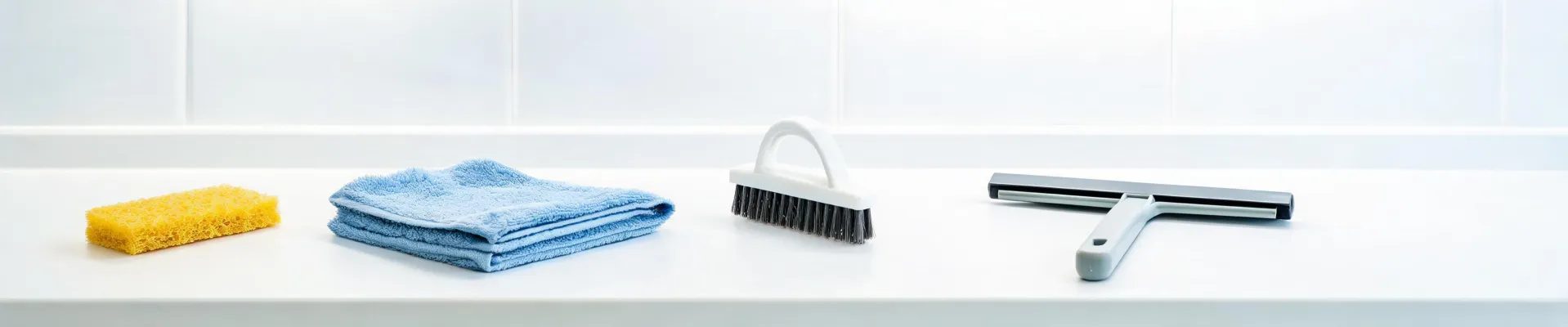
The biggest mistake in the fryer-cleaning aisle is assuming that a fryer cleaning tool has to come in a bottle. The residue left after a few batches is not loose grease; heat has turned it into polymerized oil, a hard film that soap and water cannot dissolve. Dedicated fryer sprays soften the top of that film but usually leave the polymerized layer behind, which is why the basket still feels tacky after a thorough wipe-down. The film responds to abrasion, not detergent, and that simple distinction reframes the entire purchase. I therefore argue that a 3M Scotch-Brite pad, chosen at the right hardness and kept away from non-stick coatings, is the better fryer cleaning tool for most kitchens.
The Bottle-First Habit Is the Real Fryer Problem
Why is a fryer cleaning tool assumed to mean a dedicated spray? The assumption feels natural because the store aisle is arranged that way, but it hides the actual failure. Baked-on oil is a mechanical problem before it is a chemical one. When cooking oil is heated past its smoke point and cools, it cross-links into a polymerized layer that sits on steel and enamel like a lacquer. A spray can wet that lacquer, soften its outer surface, and run off, but it cannot shear the layer away; the same sticky film remains to trap the next batch of crumbs. The question that should drive the search, then, is not which brand of fryer cleaner dissolves oil fastest. It is which abrasive tool is hard enough to break the polymerized layer, soft enough to avoid scratching the basket, and cheap enough to use across the whole kitchen. Until the search abandons the bottle-first habit, buyers will keep paying for convenience and calling it cleaning.
The reframe is supported by the product line's own definition. 3M markets Scotch-Brite not as a fryer-specific chemical but as an abrasive product line for home uses such as dish washing and scrubbing; it includes scouring pads and tools with varying compositions and levels of hardness. Evidence from the line's public description makes the point plainly: this is an abrasive family, not a chemical cleaner. That distinction changes what is being compared. A dedicated fryer spray is a fixed-formula liquid that hopes one chemistry will work on every surface, while Scotch-Brite is a graded system that lets the buyer match the abrasive to the material. It also makes my thesis concrete. For a stainless-steel, cast-iron, or enamel fryer basket, a correctly chosen Scotch-Brite pad is the better fryer cleaning tool than any single-purpose cleaner, provided the hardness is matched to the surface and the pad stays away from non-stick coatings. The cleaner offers a shortcut only if you ignore what is actually stuck to the pan.
Polymerized Grease Does Not Care About Your Spray
Understanding why basic wiping fails starts with what heat does to oil. Every fryer batch pushes oil past its smoke point, and when the oil cools, the molecules cross-link into a translucent, plastic-like film. That film is no longer grease in the usual sense; it is closer to a thin lacquer that bonds tightly to stainless steel, cast iron, and enamel. A damp cloth slides over this lacquer and picks up only the loose surface oil, so the hard polymer layer stays exactly where it was. Soap and water are effective on oil that is still liquid, but they do not break a cross-linked film; they simply lubricate it. A degreaser spray may soften the top few microns, yet the dense layer underneath remains, leaving that familiar sticky feel after the basket looks clean. This is the failure mode hiding behind nearly every fryer-cleaning search. The tool breaks before the grease does. Ordinary sponges compress, cloths glide, and brushes push the residue around; none of them has the shear needed to remove a polymerized layer. The correct tool must be abrasive enough to fracture the film and lift it from the surface in one pass.
Because the tool has to endure the same treatment as the rest of the kitchen, long-term kitchenware reviews provide a useful set of filters. The products that still look good after years of daily use are the ones that resist stains, tolerate the dishwasher, and keep their structural parts secure. In one durable pantry collection that has accumulated a huge number of owner ratings, the praise focuses on stain resistance that survives years of tomato sauce and oil, on dishwasher-safe construction, and on latches that do not crack under repeated opening. Those are exactly the standards to apply to a fryer-cleaning tool. The pad should not become a greasy, odorous sponge after one use; it should rinse clean and survive repeated dishwasher cycles without falling apart. Its structure should stay intact under the pressure needed to shear polymerized oil. A chemical cleaner cannot meet any of those filters, because it is consumed on contact and leaves behind only residue. A pad that is designed for repeated abrasion, by contrast, can meet all of them without being babied.
One Pad Beats One Bottle Across the Whole Kitchen
Once the filters are set, the comparison between a dedicated fryer cleaner and a Scotch-Brite pad becomes lopsided. The dedicated cleaner is engineered for one moment: you spray, wait, and scrub within the narrow window the formula allows. When the job is done, the bottle returns to the cabinet to occupy space until the next fryer mess, and its cost is tied to that single surface. The Scotch-Brite pad performs the same removal but does not stop there. The same abrasive that strips the polymerized oil from the basket can move to the range grates, the sheet pan, the vent filter, and the sink without any change in technique. So the real difference is not the price on the package; it is the spread of usefulness. The cleaner isolates its cost to one chore and one moment, while the pad distributes its cost across every scrubbing job in the kitchen. For a buyer who wants a versatile tool rather than a single-task consumable, the pad is the better value before you even consider effectiveness.
What makes that versatility possible is the system behind the product. The Scotch-Brite line is built as a range of abrasive pads and tools rather than a single pad with a single grit. For the buyer, this means you are not locked into one abrasive forever. You can choose a tougher pad for a carbon-steel basket, a middle grade for stainless steel, and a softer scouring sponge for enamel and glazed ceramic, all within the same product family. In daily use, this collapses several specialty bottles into a small set of abrasives that live under the sink and cover every station. One purchase can follow you from the fryer basket to the stovetop and even to the vent hood. That is what separates a true kitchen tool from a niche cleaner: the tool adapts to the material it touches, while the cleaner's formula is fixed at the factory and cannot be adjusted to the situation.
The Coating, Not the Abrasion, Sets the Boundary
The caution about abrasion is real, but it belongs to a specific surface, not to the act of scrubbing. Non-stick baskets work because of a very thin fluoropolymer layer that releases food easily. That layer is not armor; it is a coating. A coarse pad grinds into the coating in seconds, and the damage is not merely cosmetic. Once fine scratches appear, oil and food pack into the grooves, making future cleaning harder and accelerating the breakdown of the release layer. Owners often blame the pad for ruining their pan when the real culprit is using the wrong pad on the wrong material. On bare stainless steel, abrasion is the treatment that restores the surface, because it removes the polymerized oil without harming the metal. Cast iron similarly benefits from a pad that can cut through built-up residue without stripping the seasoning below the surface layer, and enamel accepts a medium abrasive when used gently. The lesson is not that pads are dangerous; it is that the coating, not the metal, sets the boundary.
That boundary becomes operational when you read the Scotch-Brite evidence carefully. Because the line spans several hardness levels, the buyer must check the surface before choosing. For uncoated stainless steel and cast iron, a heavier-duty pad is appropriate; the extra hardness is usually the safer route because it fractures the polymerized oil and removes it in fewer passes, leaving less time for friction to cause damage. For enamel and glazed ceramic, a medium or light scouring pad is the right match: enough abrasive to break the film, gentle enough to protect the glossy finish. For non-stick coatings, the correct answer is not a lower grade of Scotch-Brite; it is no Scotch-Brite pad at all. No abrasive is safe on that surface, and using one is user error rather than a product failure. This is the step that makes the whole opinion defensible. The line offers hardness exactly so the buyer can choose, and the buyer who ignores the choice ends up with the one outcome the pad is not designed to prevent.
Match the Pad to the Surface, Then Buy It
So where does the decision land the next time the fryer basket comes out brown and sticky? Start with the material and let it make the choice. A stainless-steel, cast-iron, or enamel basket should be paired with a Scotch-Brite pad in a hardness that matches the finish; the pad will shear off the polymerized layer that soap and dedicated sprays both fail to remove, and the same pad remains useful for the rest of the kitchen. This is not a marginal advantage; it is the central reason to skip the single-purpose cleaner. If the basket is non-stick, the opposite rule applies: leave the pad in the drawer and use a soft sponge or an explicitly non-scratch scrubber, because no cleaner can undo the scratches that a coarse pad would leave. The decision is therefore not between two cleaning products. It is between two paths defined by the basket's coating, and the label of the cleaner has nothing to do with which path is correct.
The whole argument can be carried in a rule short enough to survive contact with a dirty kitchen: identify the surface first, then choose the pad hardness, and never use an abrasive pad on non-stick. This rule answers the original search by telling you both what to buy and what not to buy in the same breath. It also preserves the counterintuitive insight at the center of this opinion. On bare metal, the harsher pad is often the more protective tool, because it removes the entire polymerized layer in fewer strokes, while the softer pad just thins the layer and leaves a film that will keep coming back. On a coated basket, any abrasive pad is too harsh, regardless of the marketing on the package. Keep the rule in place, and the Scotch-Brite pad is the better fryer cleaning tool for every uncoated surface, while the dedicated chemical cleaner becomes an expensive and narrow backup rather than the default solution.
Surface first, pad second, chemical last. Polymerized grease is a solid problem, and the right answer is a solid tool.

Ingrid Falk
Ingrid Falk is an outdoor living products analyst specializing in fences, pergolas, gazebos, canopies, greenhouses, shade sails, patio sets, outdoor sofas, and weatherproof cushions. She uses ISO 4892-2 and ASTM G154 weathering methods while comparing UV color change, coating adhesion, corrosion resistance, frame load, joint stability, water shedding, and dimensional movement. Her work helps garden retailers, project buyers, and hospitality operators select structures and furniture suited to wind exposure, climate, installation method, maintenance, and expected occupancy.