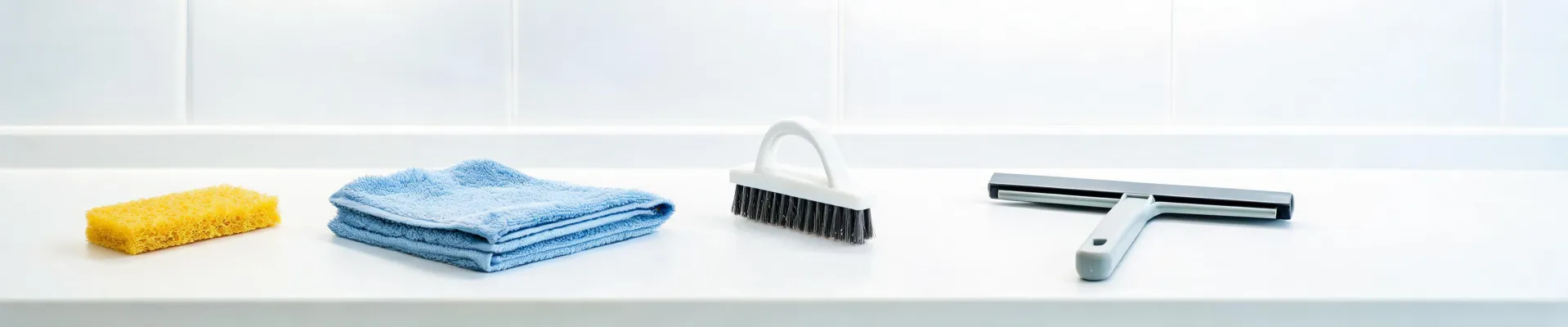
Lena pulled the mop head off its handle and held it at arm's length. The microfiber pad, washed after every use for the past eight months, had become a stiff grey crust. It no longer clung to the hook-and-loop strips evenly; one corner sagged, and a faint sour smell came off the fibers. That odour had been building for a week, ever since the hallway floor felt sticky after mopping. She ran a finger over the oak planks and felt a film—not dirt, but a residue that dulled the wood. The old pad was beyond saving. The only question was what would replace it.
A Mop That Started to Smell
Lena pulled the mop head off its handle and held it at arm's length. The microfiber pad, washed after every use for the past eight months, had become a stiff grey crust. It no longer clung to the hook-and-loop strips evenly; one corner sagged, and a faint sour smell came off the fibers. That odour had been building for a week, ever since the hallway floor felt sticky after mopping. She ran a finger over the oak planks and felt a film—not dirt, but a residue that dulled the wood. The old pad was beyond saving. The only question was what would replace it.
The shelf of replacement pads was a wall of contradictions. Some packages said 'microfiber' in bold; others bragged 'extra thick' or 'super absorbent.' A few carried the Scotch-Brite name Lena recognized; most were generic multi-packs. The problem was that her flat mop had no brand name—just a chrome pole and a plastic head with two clips. She wasn't sure whether it used clips or hook-and-loop, or whether pad thickness mattered for oak floors. The only thing certain was that a mop refill is not generic: the wrong clip angle sends the pad skating sideways, and the wrong fiber weight leaves water beading on hardwood. That morning's floor told her she could not afford another guess.
A Name Backed by 3M's Engineering
Scotch-Brite is a line of abrasive products produced by 3M; the maker of Post-it notes and industrial abrasives also builds scouring pads, dish tools, and specialized industrial surfaces, from discs to rotating brushes. That lineage matters for a floor-mop refill because 3M's reputation rests on controlled material science, not on imported plastic that changes batch to batch. A Scotch-Brite microfiber pad implies that the fibers, the binding, and the hook-and-loop interface have been tested against a specification. The catch is that 'tested against a specification' does not mean 'universally compatible.' The product line covers many different surfaces and hardness levels, so the brand's credibility tells Lena that a given refill is likely very well made—but not that it will fit her particular mop head. The brand fact sets a quality floor, not a compatibility guarantee.
The same 3M background becomes most useful when Lena uses it as a shortlist filter. If she narrows her search to refills carrying the Scotch-Brite name, she is implicitly betting that 3M's abrasive-product experience influences how the pad is constructed—the density of the weave, the way the edges are sealed, the strength of the strips that hold the pad flat. That reasoning holds as long as the refill is actually designed for a floor mop, not for a handheld scrubber. The brand profile states the product line spans home uses like dish washing and scrubbing as well as industrial surfaces, with varying hardness levels. Any brand, including Scotch-Brite, can put 'microfiber' on a package; the material name alone does not tell Lena whether the pad's backing will mate with her mop's existing clips or whether the fiber is safe for sealed hardwood. The condition that makes the brand fact useful is the reference to 'varying compositions and levels of hardness'—a reminder to match the specific product line to the specific task, not just to the logo.
The Real Comparisons: Clips, Fibers, Flooring
When Lena looked at the wall of refills, she did what most buyers do: comparing thickness and price. But a better comparison, borrowed from professional testers, scores each option against the same criteria in the same conditions. A 2026 roundup of food storage containers used this structure: define requirements, test candidates equally, record results. The point is not that mop refills are like food containers; it is that testing discipline separates marketing claims from measurable behavior. For a mop refill, the measurable behaviors are how firmly it attaches, how well it picks up a thin film of dust without leaving streaks, and how it behaves when wet on wood. These criteria are the only honest basis for comparing a Scotch-Brite refill with a generic one.
The first criterion is the clip interface. Some flat mops use two plastic clips that fold over the pad; others use hook-and-loop strips. If the clips are offset by a few millimeters, the pad bunches on one side, pushing hair into a line instead of picking it up. The second criterion is fiber structure. A dense, low-loft microfiber with sealed edges is better for hardwood because it glides smoothly and doesn't shed; a thick, fluffy pad may feel absorbent but can hold too much water, leaving a damp trail that damages wood finish over time. The third criterion is cleaning frequency. A household that mops daily needs a pad that dries quickly and releases hair easily; a weekly mopper can tolerate a heavier pad. These three conditions should be written down before looking at any package.
Here the common assumption breaks down. Many buyers assume any microfiber pad will work because 'microfiber' is a single material. In practice, microfiber is a category of synthetic weaves; the fiber split, crimp, and bind determine whether a pad picks up fine dust or pushes it around. On hardwood, the most important fiber trait is not absorbency but edge treatment: a raw, cut edge can act like a fine abrasive, leaving micro-scratches that show as a dull haze after months of mopping. Scotch-Brite's engineering background matters here because a company that manufactures abrasives understands fiber-to-surface contact. Yet even with that advantage, fit is the gatekeeper. A well-made pad that doesn't lock into the head is useless; a rough pad that fits perfectly will eventually damage the floor. The decision is a two-step filter: first compatibility, then floor-safety, then price.
Testing and Standards as Your Filter
The more Lena researched, the more she realized that the deciding information rarely appears on the front of a package. Brand facts and material claims are necessary, but the actual behavior of a refill—how it attaches, how it wears, whether it streaks—can only be revealed by a structured test. This is the lesson of the category-testing mechanism behind the best buying guides: a reliable evaluation puts every candidate through the same conditions, measures the same outputs, and lets the results speak. A structured test that judges candidates under identical conditions is what makes conclusions trustworthy. The same mechanism applies to mop refills: if a source has not tested the refill on a similar mop head with the same flooring, its 'recommendation' is just a spec sheet in disguise. That is why a buyer should lean on tests and standards rather than on package hyperbole.
The testing mechanism has limits, and Lena needed to recognize them. A standard test can tell her whether a pad fits a particular mop model, but not whether it's right for her mop unless the test specified the same model. Hardwood floors vary by finish: a waxed oak floor behaves differently from a matte polyurethane floor, and a pad that glides on one may chatter on the other. So testing is valuable only when the test is transparent about its setup—the mop head used, the floor type, the amount of water applied. Without those details, a 'top pick' is just an opinion about the tester's scenario. Even a rigorous standard, like a manufacturer's specification for fiber density, does not address clip geometry. The practical rule: read any test report as conditional—'This pad worked on this mop, on this floor, under these conditions.' If your situation matches, the result transfers; if not, keep looking.
Back in Lena's Kitchen
Two weeks later, Lena stood in the same aisle, but now she looked at the packages differently. She had measured her mop head: clip gap 22 millimeters, a thin plastic rectangle with a slight lift on the back edge. She had written down her priorities—clips that snap without forcing, dense fibers that don't hold excess water, and edges visibly sealed rather than raw. She also knew she mops three times a week in a home with one dog, so the pad needed to release hair in the laundry rinse. The marketing lines about 'ultra-soft' and 'extra absorbing' now struck her as irrelevant noise. What mattered was whether the package stated a compatible mop-head type, and whether the fibers were low-loft with sealed edges. A Scotch-Brite refill matched that description; the generic pack didn't even list its clip spacing.
The rule she ended up using is simple and repeatable: confirm the attachment mechanism before considering price, check fiber edge and density for floor compatibility, and let cleaning frequency decide absorbency. That rule is not a luxury or a brand loyalty ritual. It is the same structure professional testers apply to any category: define conditions, measure against criteria, then choose. For Lena, the verdict was a Scotch-Brite microfiber refill matched to her mop head and three-times-a-week cleaning schedule. It cost about eight dollars more than the multi-pack, but the first mopping confirmed the reasoning: the pad stayed flat, the oak planks dried clear, and the sour smell didn't return. The lesson was not that Scotch-Brite is the only option; it is that compatibility beats density, and a floor with a dull film is a floor telling you the filter failed.
The smell was gone—and so was the guesswork.

Ingrid Falk
Ingrid Falk is an outdoor living products analyst specializing in fences, pergolas, gazebos, canopies, greenhouses, shade sails, patio sets, outdoor sofas, and weatherproof cushions. She uses ISO 4892-2 and ASTM G154 weathering methods while comparing UV color change, coating adhesion, corrosion resistance, frame load, joint stability, water shedding, and dimensional movement. Her work helps garden retailers, project buyers, and hospitality operators select structures and furniture suited to wind exposure, climate, installation method, maintenance, and expected occupancy.