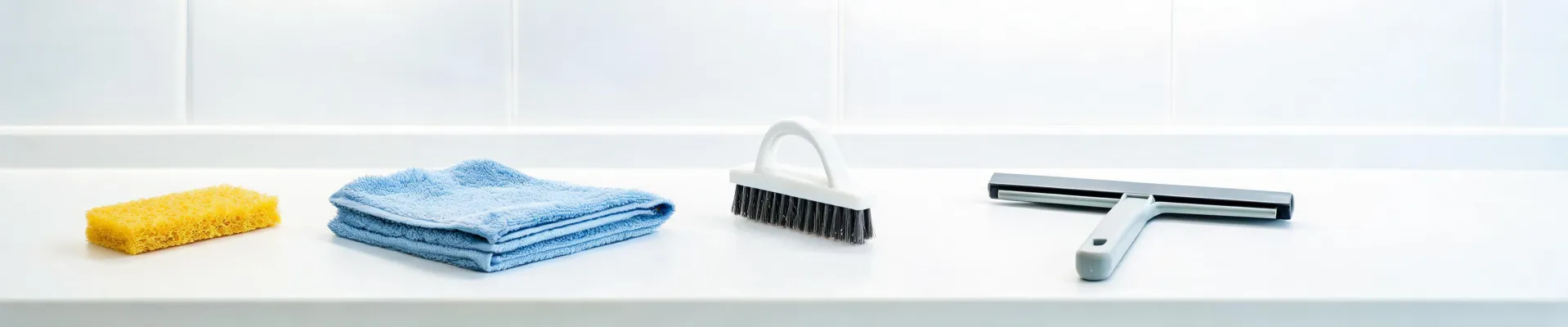
You step out of the shower and see it again: a translucent film on the tiles, white streaks on the glass door. Wiping with a sponge only smears it. That clinging layer is not dirt—it is bathroom buildup, a mineral-and-soap residue bonded to the surface. A stronger spray will soften it, but removal has to be mechanical, because the film needs breaking. That is where an abrasive scrub like the Scotch-Brite Swift Scrub comes in, if you match its hardness to your surface.
The film that laughs at soap
So why does the film stay when a cloth or sponge just moves it? Because bathroom buildup is not a layer of dust; it is a bonded deposit that resists casual wipes. Soap scum, hard-water minerals, and skin oils combine into a tough skin on the tile or glass. A chemical spray can soften that skin, but it cannot break the bond underneath. To remove the film, you have to interrupt the bond with friction—small, controlled abrasive action that cuts through the deposit without damaging the surface beneath it. That is why the tool matters more than the product.
Picture this: you're in the shower, the water is beading, and the wall looks hazy. Run your finger along the glass door and it squeaks; the film is there even after a rinse. A standard sponge loaded with cleaner creates suds, but when you wipe, the suds part and the haze remains. You might try a nylon brush, which lifts some of it but leaves streaks. What you are watching is the film resisting a chemical approach. The deposit is partly mineral, and minerals do not dissolve in soap; they need to be broken away with an abrasive surface. This is the moment to stop thinking about spray and start thinking about grit.
So where do you find that grit? The Scotch-Brite line, made by 3M, is built around exactly this idea: it is a line of abrasive products with varying compositions and levels of hardness, designed for everything from dish washing to industrial surface preparation. That variation is the key: a single brand offers pads that range from gentle non-scratch options to aggressive heavy-duty scrubs, which means the choice of which pad to use becomes a deliberate match between hardness and surface. The brand fact matters because it turns 'I need a stronger scrub' into a rational selection process: you identify the surface, estimate the buildup level, and pick an abrasive hard enough to cut through the film but not so hard that it scratches the finish.
Hard water plus soap plus skin equals the clingy film
Bathroom buildup has three ingredients, each adding to the bond. Hard water contains dissolved calcium and magnesium; when water evaporates, those minerals form tiny crystals that grip the surface. Soap, especially bar soap, reacts with those minerals to create soap scum, a waxy, water-repellent compound that does not rinse away. Skin oils add an organic glue that helps the mixture set into a continuous film. Together, the three create a deposit part crystal, part wax, part grease—unlike simple dirt. Each component alone might rinse off, but the combination forms a stable layer that resists plain water. So no single chemical removes all three equally well; the crystals especially need physical interruption to break them up.
The clinginess comes from the way the mixture sets. As water evaporates, mineral crystals grow into irregular shapes that lock onto the roughness of tile, glass, and acrylic. Soap scum fills the gaps between crystals, creating a smooth outer layer. Skin oils penetrate the lower part, making it resistant to cracking. So when you wipe, the film bends instead of breaking, and the cloth skims over. A chemical spray can soften the oily component, but the mineral crystals remain; they are the skeleton. That skeleton is why you need an abrasive pad: it physically breaks the crystalline lattice. The softer the pad relative to the deposit, the longer you scrub; the harder the pad, the faster the break—but also the higher the risk of scratching. This trade-off is the core.
The hardness scale that separates fast from scratched
Hardness matters because abrasive tools are not one-size-fits-all. Scotch-Brite, a 3M line, offers pads and tools in a range of hardness levels, from soft sponges safe on non-stick cookware to coarse scrubbers for industrial metal. The right abrasive depends on what you are cutting. On a bathroom surface, the film is the target, but the surface underneath is fragile. A pad too soft will just polish the film, leaving the deposit intact. A pad too hard will cut through the film but also bite into acrylic, enamel, or tile. The brand evidence gives you the vocabulary: you are choosing a specific hardness from a known scale, not grabbing whatever sponge is in the caddy. That single fact turns the scrub from a guessing game into a deliberative match.
How do you make that match deliberately? The same way expert reviewers choose a product: they define criteria, run hands-on tests, and check specs. Product-testing teams, for instance, evaluate food storage containers by setting clear standards like leakproofness and durability, testing candidates, and checking specs. That structure transfers directly to choosing a scrub pad. Your criteria are surface type, buildup level, and speed. Your test is a small corner: try a middle-hardness pad with light pressure for a few strokes. Your spec check is the pad's label, telling you what it is meant for. The review methodology removes wishful thinking: instead of hoping a stronger cleaner will do it, you measure whether the tool's hardness matches the job. That is how you avoid both the too-soft trap and the too-hard mistake.
The break-the-buildup method that starts with a look
Before you scrub, look at the surface you are cleaning. Glass shower doors are hard and non-porous, so they take a medium abrasive with little risk. Ceramic tile is durable, but the grout needs gentler handling. Acrylic tubs scratch easily, then they attract more buildup. Enameled steel is in between—hard enough for a medium pad but not coarse grit. The surface determines your starting hardness. If unsure, start with a pad labeled non-scratch or medium, and test it in a small area. This first look is the most skipped step—and skipping it brings a scratched tub or a film that won't budge.
With the surface identified, follow a clear sequence: wet, apply, scrub, rinse, inspect. Wet the surface with warm water; it softens the soap and helps the abrasive glide. Apply the pad with a small amount of cleaner, or just the pad itself. Scrub with short, controlled strokes, letting the abrasive do the work, not your arm. Rinse thoroughly and inspect under good light. If the film is gone, you're done; if it remains, step up one level. This mirrors how product testers work: define a procedure and follow it. The expert review method applies: run a hands-on test, check the result, and adjust one variable. That is how you remove buildup without damaging the bathroom.
Pressure is the variable most people get wrong. The fastest scrub uses a mid-hardness pad with light, controlled pressure, not force. Pressing hard digs the grit deeper, cutting through the film but also scratching the finish. Light pressure keeps the grit on the film's surface and breaks the bond controllably. If you see fine scratches, you pressed too hard; switch to a softer pad. If you scrub long without progress, the pad is too soft; move up one level. Caution: respect the surface. Acrylic and fiberglass need gentlest touch; glass and tile tolerate more. When in doubt, err on softer side and add passes rather than pressure.
When the shower is clear again: your callback rule
Back in the shower, the same translucent film is on the tiles and the glass door is streaked. But now you are not reaching for the spray bottle. You glance at the surface, recall its hardness, and pick a mid-range pad. You wet the wall, run the pad in short strokes, rinse, and check. The film lifts—not because the chemical changed, but because the abrasive finally matched the job. This is the field-guide difference: the cleaning session becomes a sequence of decisions, not a random attempt. The scene is the same, but your reaction is no longer a guess.
The simple rule is: if the film remains after a fair try, step up one level; if you see scratches, step down one level. It works for any buildup, any surface, any bathroom. It also tells you when to stop—when the film is gone and the surface unmarked, you're done. You do not need to scrub until the surface gleams; you need to scrub until the deposit is broken. The rule replaces the vague 'I need a stronger cleaner' with a concrete action. It honors the core truth: bathroom buildup is a mechanical problem that responds to the right abrasive, so the skill is not in scrubbing harder but in matching the tool to the job.
Next time the film laughs at your sponge, remember: it is a hardness-matching problem, and you have the rule to solve it.

Ingrid Falk
Ingrid Falk is an outdoor living products analyst specializing in fences, pergolas, gazebos, canopies, greenhouses, shade sails, patio sets, outdoor sofas, and weatherproof cushions. She uses ISO 4892-2 and ASTM G154 weathering methods while comparing UV color change, coating adhesion, corrosion resistance, frame load, joint stability, water shedding, and dimensional movement. Her work helps garden retailers, project buyers, and hospitality operators select structures and furniture suited to wind exposure, climate, installation method, maintenance, and expected occupancy.