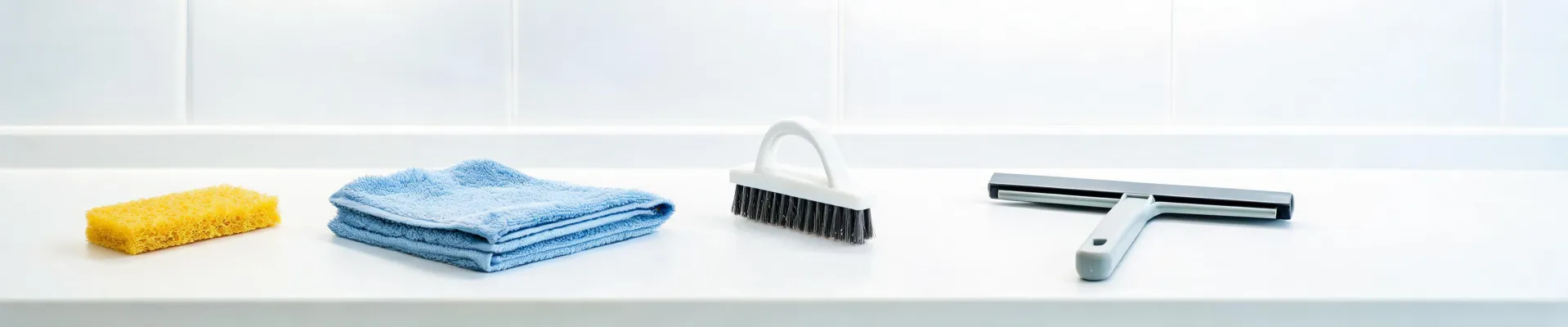
You've just finished mopping the kitchen floor, and instead of the clean gleam you expected, you're staring at a streaky mess. The old mop head sheds lint with every pass, leaving a trail of gray fibers along the baseboards. The water seems to bead up on the tile rather than soak into the cloth, so you're pushing the same puddle around, watching it pick up dust and then deposit it somewhere else. By the time you're done, your back hurts, the floor still smells sour, and you're already dreading the fact that you'll have to do this again in two days. You glance at the mop handle, a cheap twist-style thing you bought on impulse, and wonder if this is really the best tool for the job. Perhaps you've noticed that the "grabby" fibers advertised on the package didn't survive the first wash. The pad is now thin and matted, so every stroke just redistributes the grime. And the handle, which seemed sturdy in the store, now creaks and twists in your hands, forcing you to compensate with awkward body angles. This is the moment when most people shrug and blame themselves for not cleaning often enough. But the real culprit is hiding in plain sight: the mop itself.
The Morning Mop: A Scene of Frustration
You've just finished mopping the kitchen floor, and instead of the clean gleam you expected, you're staring at a streaky mess. The old mop head sheds lint with every pass, leaving a trail of gray fibers along the baseboards. The water seems to bead up on the tile rather than soak into the cloth, so you're pushing the same puddle around, watching it pick up dust and then deposit it somewhere else. By the time you're done, your back hurts, the floor still smells sour, and you're already dreading the fact that you'll have to do this again in two days. You glance at the mop handle, a cheap twist-style thing you bought on impulse, and wonder if this is really the best tool for the job. Perhaps you've noticed that the "grabby" fibers advertised on the package didn't survive the first wash. The pad is now thin and matted, so every stroke just redistributes the grime. And the handle, which seemed sturdy in the store, now creaks and twists in your hands, forcing you to compensate with awkward body angles. This is the moment when most people shrug and blame themselves for not cleaning often enough. But the real culprit is hiding in plain sight: the mop itself.
Standing there with a dripping mop, you might ask a simple question: why doesn't this thing actually absorb water? The answer isn't about your cleaning technique—it's about how the mop is designed. Most people assume a mop is a low-tech product, a stick with fabric on the end, and that any differences beyond price are cosmetic. But that assumption is exactly what keeps you stuck with a tool that leaves streaks. The truth is, the material of the mop pad, the structure of the handle, and the way the cloth is woven determine how much water it can hold, how evenly it distributes pressure, and how long it will last. In other words, a mop has specifications worth reading, just like a smartphone or a washing machine. The challenge is that nobody tells you which numbers matter. When you stand in the aisle, you see a $10 generic mop and a $30 Scotch-Brite mop with fancy claims—"super absorbent," "magic scrub"—and you have no way to tell if the extra cost is justified. So you default to price, or to the brightest package, and you end up right back here, with a floor that's clean-ish and a vague feeling of being ripped off.
What Wi-Fi Sprinklers Taught Me About Mopping
Consider how modern irrigation controllers solved a similar problem. The Orbit B-hyve, for example, connects to your home Wi-Fi and checks hyperlocal weather multiple times a day. If rain is in the forecast, it skips a watering cycle; if the day turns hot and dry, it adds more time. The system doesn't just run on a fixed schedule—it responds to actual conditions. This is what engineers call "on-demand operation," and it saves both water and the homeowner's mental energy. Now think about your mop. When you drag it across the floor, does it respond to the amount of water present? Does it release water only where the floor is dirty, or does it just leave a uniform wetness that evaporates into streaks? Most mops operate in a binary way: they're either soaked or dry. They don't adjust to the surface or the soil level. That's the first lesson from the smart sprinkler: a tool that adapts to real-time feedback can outperform one that follows a blind routine. The technology isn't about adding buttons—it's about sensing the environment and acting accordingly, which is exactly what a good mop should do.
Of course, the smart sprinkler's magic has a condition. A study from Utah State University compared Wi-Fi-enabled controllers with manually programmed ones and found that the smart versions reduced water application while maintaining plant health—but only when the system was properly configured with accurate landscape data. If you set it up wrong, or if your soil type is unusually heavy, the controller might skip a needed watering or overwater a stressed lawn. The takeaway for cleaning is similar: an "adaptive" mop only helps if you understand its limits. For instance, a microfiber pad that's great for sealed hardwood may be useless on uneven ceramic tile, because it can't wring out enough pressure to reach the grout. The technology can't compensate for a mismatch between the tool and the surface. So before you upgrade, you need to know what conditions your mop will face.
What's even more revealing is that the B-hyve ecosystem has spawned an open-source community. A custom component called bhyve-home-assistant lets homeowners integrate their irrigation controller with a smart-home hub, so they can create their own watering rules based on sensor data or time of day. This flexibility shows that a well-designed tool doesn't lock you into a single behavior—it can be adapted to your routines. A mop, in the same spirit, should offer choices: a pad that can be swapped between coarse scrubbing and fine absorption, a handle that adjusts for reach, or a wringer that lets you control moisture level on the fly. When a product is designed as a system rather than a fixed gadget, it stays useful longer and handles more situations. Think of it as the difference between a basic timer and a programmable controller—the latter costs more, but it pays off in versatility.
From Stainless Steel to Mop Cloth: Material Matters
The smart irrigation example changed your mental model, but the physical reality of a mop still comes down to materials. And here, the world of metallurgy offers a striking analogy. Stainless steel isn't a single substance; it's an alloy—iron with at least 10.5% chromium, plus small amounts of carbon and other elements. That specific recipe gives the steel its rust resistance and durability. Similarly, a mop pad's performance is not about a marketing buzzword like "microfiber"—it's about the exact blend of fibers, their density, and how they're spun. A pad that's mostly polyester might be cheap, but it won't hold much water. A blend with a higher percentage of nylon or a unique triangular-lobe shape creates capillary channels that trap liquid and dirt. The material composition isn't cosmetic; it determines whether you'll be re-wiping the same spot or actually lifting the grime away.
All-Clad, the premium cookware brand, built its reputation on a simple insight: instead of using a single metal, it bonds layers of stainless steel around an aluminum core. The aluminum conducts heat fast and evenly, while the steel protects against scratching and warping. This multi-layer construction, invented in the 1970s, is the reason a $200 pan outperforms a $20 one. Now transfer that logic to a mop head. A cheap mop often uses a single slab of foam or a thin sheet of cloth, which collapses under pressure and can't maintain contact with the floor. A better mop might layer a microfiber top for absorption, a middle spacer for structure, and a textured bottom for scrubbing. Each layer serves a function, and together they create a tool that distributes your weight evenly, so you're not pressing hard to get the corners clean. The construction matters more than the brand logo.
But even the best materials have a catch: they need proper care. All-Clad's own care guide stresses that cleaning methods vary by material—stainless steel requires different handling than nonstick, and using the wrong technique can ruin the surface. The same principle applies to mop pads. Many microfiber mops lose their effectiveness if you wash them with fabric softener, which coats the fibers and blocks their absorbency. Others need to be air-dried to prevent mildew. And regardless of how well you maintain a pad, it will eventually wear out; the high-performing layers degrade with each wash. If you ignore these conditions, you'll be back at the beginning—a mop that leaves streaks, and a strangely resentful feeling toward a product that promised "magic" but demanded more careful stewardship than you expected.
The 5-Second Spec Check for Mops
The smart sprinkler demonstrated on-demand logic, and the cookware illustrated material science. But when you stand in the cleaning aisle, you still need a concrete way to compare products. The irrigation industry offers a model: every timer controller has a specification sheet that lists its pressure range (for example, 5-15 PSI minimum to 120 PSI maximum) and flow rate (say, 8 gallons per minute). These numbers tell you whether the device will work with your water supply. A mop should be evaluated with similar rigor. Look for the pad's absorbency measured in fluid ounces per square foot—a quality pad might hold 2.5 ounces per square foot, whereas a bargain pad might only hold 0.8. Also check the handle's weight, the pad's edge profile, and whether it can be machine-washed without disintegrating. A spec sheet for a mop is not a fantasy; it's a set of measurements that separate tools from toys.
The construction world takes such numbers so seriously that it codifies them into engineering standards. China's CECS 243:2008 for landscape irrigation, for example, details design parameters, hydraulic calculations, and equipment selection, ensuring that a system won't fail under unexpected pressure. The newer T/ZPP 184-2025 guideline goes further, adding soil moisture monitoring and maintenance rules. These documents exist because vague marketing claims are worthless when a system has to actually perform. For a mop, there's no equivalent standard—but you can create your own. When you pick up a mop, check the label for fiber weight (g/m²), the pad's stiffness rating, and the handle's locking mechanism. Run a quick mental test: if the pad doesn't have any measurable absorbency number, assume it's a toy. If the handle wobbles when you shake it, put it back. This five-second spec check, borrowed from engineering practice, filters out 80% of the garbage products without reading a single review.
The Turnaround: Mopping With Intent
Now you have the tools to make an informed choice. The final lesson comes from the kitchen: how to check compatibility. All-Clad pans are marked by whether they work on induction stoves, and the simplest test is to stick a magnet to the underside—if it clings, the pan has ferromagnetic material and will heat. The same idea applies to a mop: before buying, match the pad to your specific floor type. A magnet won't help here, but a few questions will. Does your floor have wide grout lines? Then you need a hard-bristled brush edge, not just a flat cloth. Is it all hardwood? Then you need a pad with high absorbency and a squeegee action to minimize water contact. Are you on tile with a rough texture? A dense microfiber with a scrubbing strip will outperform a delicate chenille pad. The compatibility test turns a generic "great mop" into a specific, calibrated tool for your home. Don't buy the one the influencer likes; buy the one that passes your floor's test.
So when you stand in the cleaning aisle next Saturday, the decision no longer feels like a gamble. You run the spec check, you think about your grout, you look for a pad with a number next to "absorbency." You may even recall the All-Clad litigation over cookware marketing, which reminds you that even trusted brands overdramatize "revolutionary" surfaces. That skepticism is healthy. You pick a mop that fits your floor's personality—not the one with the flashiest packaging. And when you get home, you mop with intent: you wring it properly, you wash in sections, you watch the water go from murky to clear. The floor dries without streaks. The ache in your shoulders is gone. The morning ritual no longer feels like a punishment; it feels like a system that works for you. That's the quiet reward of evaluating a simple tool with the same rigor you'd apply to a smart sprinkler or a stainless steel pan.
So when you stand in the cleaning aisle next Saturday, the decision no longer feels like a gamble. Run your quick spec check, picture your grout lines and your floor's texture, and look for a pad that actually states its absorbency. Remember the All-Clad litigation: even trusted brands hype 'revolutionary' surfaces. That skepticism is healthy. Pick a mop that fits your home, not the one with the flashiest packaging. When you mop with intent—wringing properly, working in sections—the water goes from murky to clear, the floor dries streak-free, and your shoulders don't ache. The morning ritual becomes a system that works for you. That's the quiet reward of applying engineering rigor to a simple tool.

Ingrid Falk
Ingrid Falk is an outdoor living products analyst specializing in fences, pergolas, gazebos, canopies, greenhouses, shade sails, patio sets, outdoor sofas, and weatherproof cushions. She uses ISO 4892-2 and ASTM G154 weathering methods while comparing UV color change, coating adhesion, corrosion resistance, frame load, joint stability, water shedding, and dimensional movement. Her work helps garden retailers, project buyers, and hospitality operators select structures and furniture suited to wind exposure, climate, installation method, maintenance, and expected occupancy.